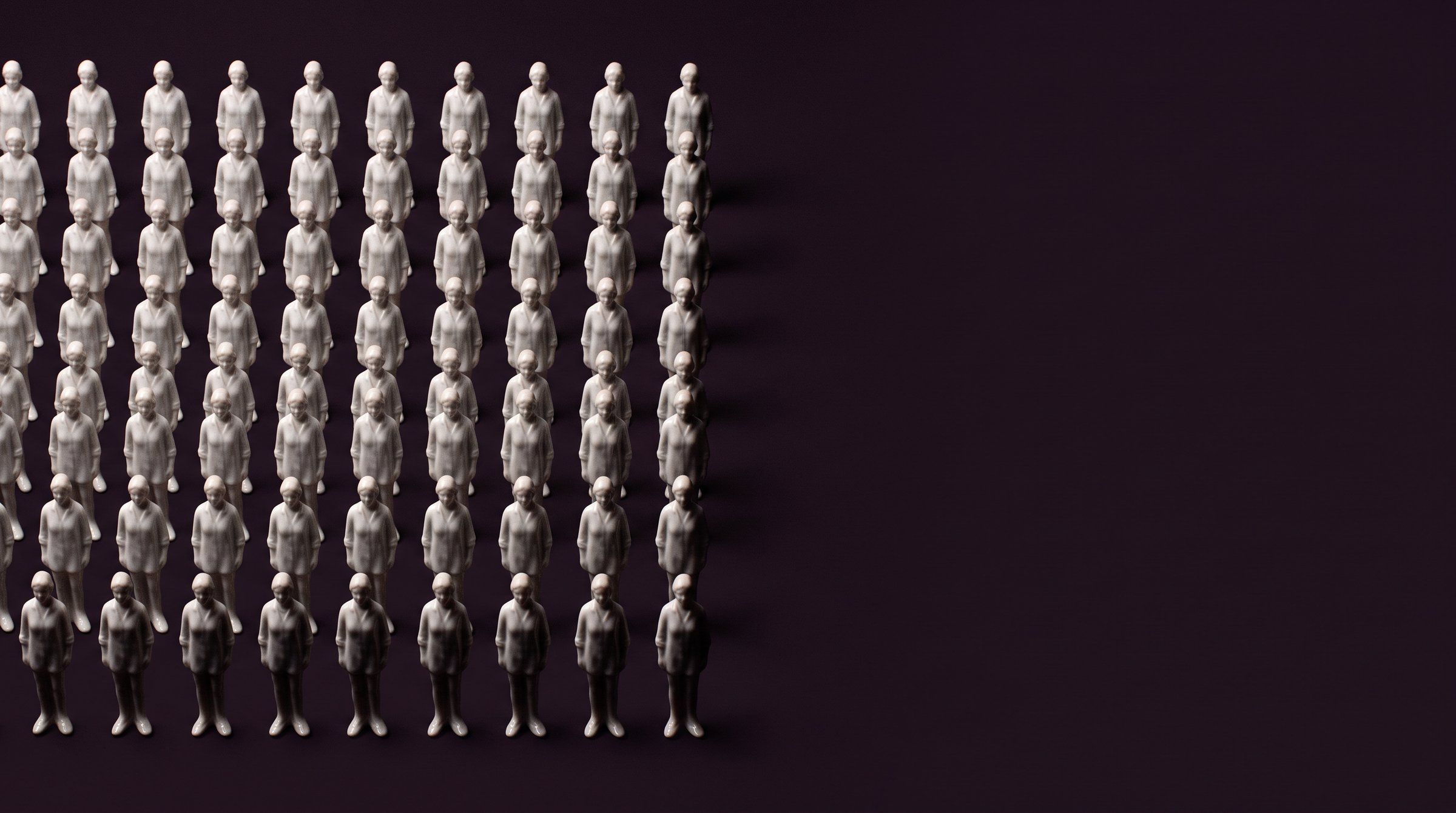
The quickest way to spot weak AI video is to watch the main character across a cut. The jaw shifts. The jacket changes colour. The scar moves to the other cheek. That's drift: the model reinventing a character with every new shot. One shot can look great. Forty shots of the same person is a different problem.
None of what follows is secret or a single trick. It's production discipline applied to a medium that doesn't come with any.
Why drift happens
A generative model doesn't remember your character between shots. Every generation starts from noise, a random starting point, and builds an image to match its instructions. Change the instructions or the random start slightly, and you get a slightly different person. Across a long sequence the differences add up.
So the work is removing every variable we can, and catching the ones we can't.
Locked reference images
Before any shot is made, each character gets a reference set: front, profile, three-quarter and full length, in the film's wardrobe and light. Once approved, it's locked, and every shot is generated against it.
A small set of style frames does the same for the palette, lens feel and grade, so shot 38 matches the same target as shot 1.
A fixed character description
Each character also gets a written description that never changes: age, build, face, hair, wardrobe. We call these anchor strings, and the same words go into every shot. Paraphrasing one is a fast way to get a different person back.
Where the model allows, we also fix the seed, the random starting point, so a shot can be repeated exactly for a small change.
Chaining the last frame into the first
Within a sequence, the final frame of one clip becomes the starting frame of the next. It keeps position, wardrobe and light continuous across the cut, the way a continuity supervisor would on set.
A chain carries a mistake forward as faithfully as everything else, which is why the next step matters most.
A pass or fail check on every shot
Every shot is checked against the references before it goes into the cut, and it passes or it doesn't. We look at:
- Face and build against the locked reference.
- Wardrobe, props and any marks that should stay put.
- Hands, text and logos, which models still get wrong.
- Light direction and colour against the style frames.
- Continuity with the shots either side of it.
A failed shot is corrected or regenerated, and the check is recorded, so "is this on-brand?" has an answer, not an opinion.
What we won't promise
We won't promise zero drift. Models still wander. We promise drift is caught and corrected before the work reaches you, and the check behind every shot is documented.
Extreme close-ups, fast action and characters handling each other are harder to hold than a steady mid shot. If a sequence leans on those, we plan around them, or suggest shooting that moment for real.
One good shot proves the model. Forty consistent shots prove the process.
Why it matters beyond looks
A character who changes face between shots breaks the story. For a brand mascot or spokesperson it breaks recognition, the whole point of having one. One good shot shows a model can do something. A long sequence that holds shows it can be done on schedule.
The methods scale down too: a four-shot social piece gets the same references and the same check per shot.
Consistency is in the price: our AI Short, a finished 30 to 60 second film at $15k to $25k ex GST, includes a pass or fail check on every shot.